
What is Agentic AI
Agentic AI is an advanced form of artificial intelligence designed to pursue complex goals or tasks with the autonomy, rather than simply responding to regular prompts. While traditional chatbots waits for user input to produce content, agentic AI can independently plan...
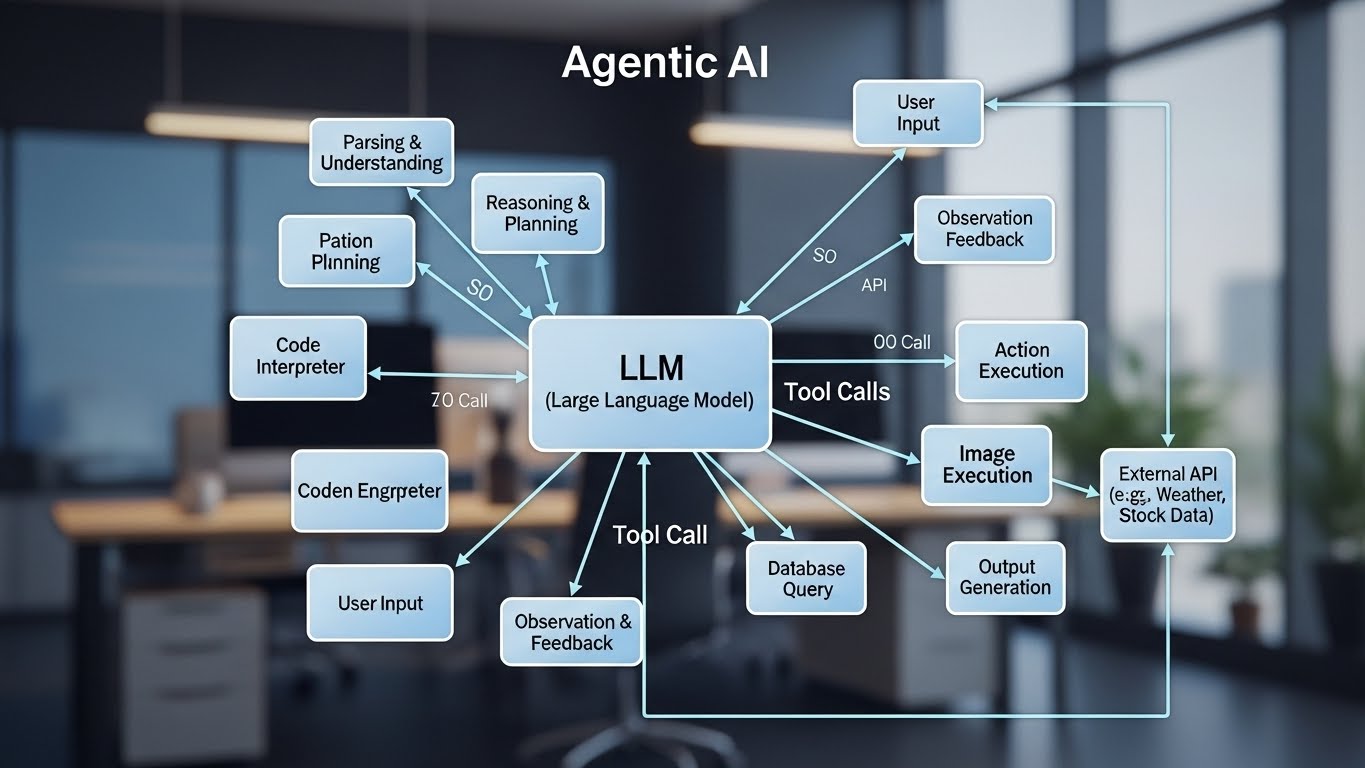
Core Principle:
The Transition from "Chat" to "Action" The central characteristic of Agentic AI - the ability to act independently. In addition to merely answering a user inquiry, an Agentic can be seen as a Digital Worker which can:1- Reason & Plan:
Take a general goal (for example "Create a Marketing Campaign") and break it into several smaller and more easily managed tasks.2- Use Tools:
Interact with other software systems, APIs, and/or databases (send emails, query a Customer Relationship Management database, run code etc.) to complete the individual tasks.3- Self Correct:
Continuously monitor its own performance; If an initial effort fails (the target web site was unavailable, etc.), it will automatically alter its approach to try to complete the task without needing any assistance from humans.Agentic AI vs. Generative AI
Although Agentic AI frequently utilizes Large Language Models (LLMs) as the "brain" behind its decision making capabilities, it is fundamentally different from typical Generative AI in both its scope and function.Practical Uses of Agentic AI
Agentic AI is currently being used to automate a wide variety of complex workflows for large enterprises:Customer Service:
Rather than simply providing a link to a help article, an Agent can confirm a user's transaction history, detect a billing discrepancy, generate and send a credit for the amount of the discrepancy, and send a follow-up confirmation to the user.Software Development:
Agents can create code, run automated tests, identify bugs based upon the test results, and then implement fixes which they have identified by deploying the fix, thereby acting as an autonomous programmer.Operational Processes:
An agent could reschedule employees working shifts at short notice when one of their colleagues calls out sick, and notify all affected staff members as well.How It Works
Agentic systems are typically built as a network of specialized agents or a single orchestrator that follows a loop of Perception, Reasoning, and Action:Perception:
The AI analyzes the user's goal and its current environment (e.g., checking a calendar or database).Reasoning:
It uses an LLM to formulate a plan, deciding which tools are needed (e.g., "I need to query the SQL database first, then format the data with Python").Action:
It executes the necessary function calls or API requests.Observation:
It reviews the output of its action. If successful, it proceeds; if not, it iterates on its plan.Example#1
Foodpanda Agent Flow
👱 USER
         │
         │ "Get me a burger"
         │
         ▼
    🤖 AI AGENT  ◄──────────┐
         │                  │
         │ (1) Decides to   │ (2) Returns
         │     check menu   │     prices
         │                  │
         ▼                  │
  🛠️  TOOLS (API) ──────────┘
      (Foodpanda)
The Step-by-Step Flow (Best for deep dive)
START
  │
  │  1. 👱 USER SAYS:
  │  "I want a pepperoni pizza from Papa Johns."
  │
  ▼
[ 🧠 AI BRAIN ]
  │  "I need to check the price first."
  │  Selects Tool: get_menu()
  │
  ▼
[ ⚡ FOODPANDA SYSTEM ]
  │  "Medium Pepperoni is $12."
  │  (Data sent back to AI)
  │
  ▼
[ 🧠 AI BRAIN ]
  │  "Okay, I have the price."
  │  (Formulates reply to user)
  │
  ▼
  │  2. 🤖 AI ASKS USER:
  │  "A medium pepperoni is $12. Should I order it?"
  │
  ▼
  │  3. 👱 USER REPLIES:
  │  "Yes, please."
  │
  ▼
[ 🧠 AI BRAIN ]
  │  "User confirmed. Executing order."
  │  Selects Tool: place_order()
  │
  ▼
[ ⚡ FOODPANDA SYSTEM ]
  │  Processing Payment... Success!
  │  Order ID: #9955
  │
  ▼
[ 🧠 AI BRAIN ]
  │  "Order successful."
  │
  ▼
END
  │  4. 🤖 AI CONFIRMS:
  │  "Done! Order #9955 is on the way."
  │
  ▼
😋 HAPPY USER
Example#2
Telecom Support Agent
This agent acts as the first line of defense for a customer support center. Instead of making users wait on hold for a human, the AI Agent handles the initial troubleshooting. It has access to "Tools" that allow it to verify customer identity, check the technical status of their equipment (e.g., a router), and issue remote reset commands. If it cannot solve the problem, it escalates the issue to a human ticket.
START
  │
  │  1. 👱 USER CALLS/CHATS:
  │  "My internet stopped working suddenly."
  │
  ▼
[ 🧠 AI BRAIN ]
  │  "I need to find their account first."
  │  (Asks user for details)
  │
  ▼
  │  2. 🤖 AI REPLIES:
  │  "I can help. What is your account number?"
  │
  ▼
  │  3. 👱 USER REPLIES:
  │  "It's 882-991."
  │
  ▼
[ 🧠 AI BRAIN ]
  │  "Verifying account..."
  │  Selects Tool: verify_user("882-991")
  │
  ▼
[ 🏢 CRM SYSTEM ]
  │  "User Found: John Doe. Plan: Fiber 100."
  │  (Data sent back to AI)
  │
  ▼
[ 🧠 AI BRAIN ]
  │  "User is valid. Now checking line health."
  │  Selects Tool: diagnostic_test("882-991")
  │
  ▼
[ 📡 NETWORK TOWER ]
  │  Error Found: "Port Frozen / Signal Jammed"
  │  (Data sent back to AI)
  │
  ▼
[ 🧠 AI BRAIN ]
  │  "I see the error. I can reset this remotely."
  │  Selects Tool: reset_port("882-991")
  │
  ▼
[ 📡 NETWORK TOWER ]
  │  ... Resetting ...
  │  Signal Restored. Status: Online.
  │
  ▼
END
  │  4. 🤖 AI CONFIRMS:
  │  "I found a signal jam and reset your line.
  │   Your internet should be back now!"
  │
  ▼
😊 HAPPY USER
Pros of Using Agentic AI
Autonomous Action Unlike standard chatbots that only give advice, Agents can actively do things. They connect to your external software to book flights, reset passwords, or update databases without the human help.
Complex problem solving Agents can break down vague instructions ("Plan my trip") into a logical sequence of steps. They can reason, try a solution, check if it worked, and correct themselves if it failed.
Dynamic adaptability you don't need to hard-code every single scenario. If you give an Agent a set of tools (calculator, search, database), it will figures out on its own which tool to use for the current problem.
Cons of Using Agentic AI
Latency (Slowness) Agents are slower than standard bots. Because they have to "think," call a tool, wait for the result, and "think" again, a simple reply can take 5–10 seconds longer than usual.
Higher Costs Agents require more processing power. Every time the agent loops to check a tool or verify a result, it consumes more "tokens" (API credits), making them more expensive to run per user.
Unpredictability traditional code always behaves the same way. Agents are probabilistic; occasionally, they might choose the wrong tool or get stuck in a loop trying to solve a problem that is impossible, requiring strict safety limits.
1. Leading Open-Source Frameworks & SDKs
These are the primary toolkits used by developers to build, orchestrate, and manage agent state and memory.
LangGraph (by LangChain):
Currently the industry standard for building complex, stateful agents. It uses a graph-based approach (nodes and edges) to handle cycles and persistence, making it ideal for non-linear workflows.
CrewAI:
Focuses on "role-playing" autonomous agents. It allows you to define a "crew" with specific roles, goals, and backstories, facilitating collaborative task execution.
AutoGen (by Microsoft):
A framework specifically designed for multi-agent conversations. It excels in scenarios where agents need to "talk" to each other to solve a problem.
Pydantic AI:
A Python-native framework that leverages Pydantic for strict data validation and type safety, making it a favorite for production-grade backend engineering.
Agno (formerly Phidata):
Specialized in building agents with memory, knowledge, and tools using a simplified, modular structure.
Haystack (by deepset):
A versatile framework focused on RAG (Retrieval-Augmented Generation) and modular AI pipelines that can easily be extended into agentic behavior.
Mastra:
A newer, high-performance TypeScript-native framework for developers who prefer JS/TS over Python for building agentic workflows.
2. Model-Specific & Cloud SDKs
Official toolkits provided by major AI labs to build agents specifically optimized for their own models.
OpenAI Agents SDK:
A lightweight, official SDK from OpenAI for building agents that utilize their latest reasoning and function-calling capabilities.
Claude Agent SDK (Anthropic):
Specifically designed to leverage Claude’s high-context window and "computer use" capabilities.
Google Agent Development Kit (ADK):
The native pathway for building agents within the Google Vertex AI and Gemini ecosystem.
Semantic Kernel (Microsoft):
An enterprise-grade SDK that integrates AI agents into traditional software environments like C#, Python, and Java.
Amazon Bedrock Agents:
A fully managed service that allows you to build and deploy agents within the AWS infrastructure.
Ready to Build Something Great?
Let's discuss how we can help transform your business with AI-powered solutions.
Get in Touch